Reaches · June 2026
A slow tributary through cypress and tupelo
A river that barely moves, running through swamp forest inside the city limits, best seen from the water.
- Where
- Tributary swamp, east of Memphis
- Water
- Tributary gauge 3.1 ft
- On foot
- Water only, or a mile of boardwalk
- Written by
- Hollis Mabry
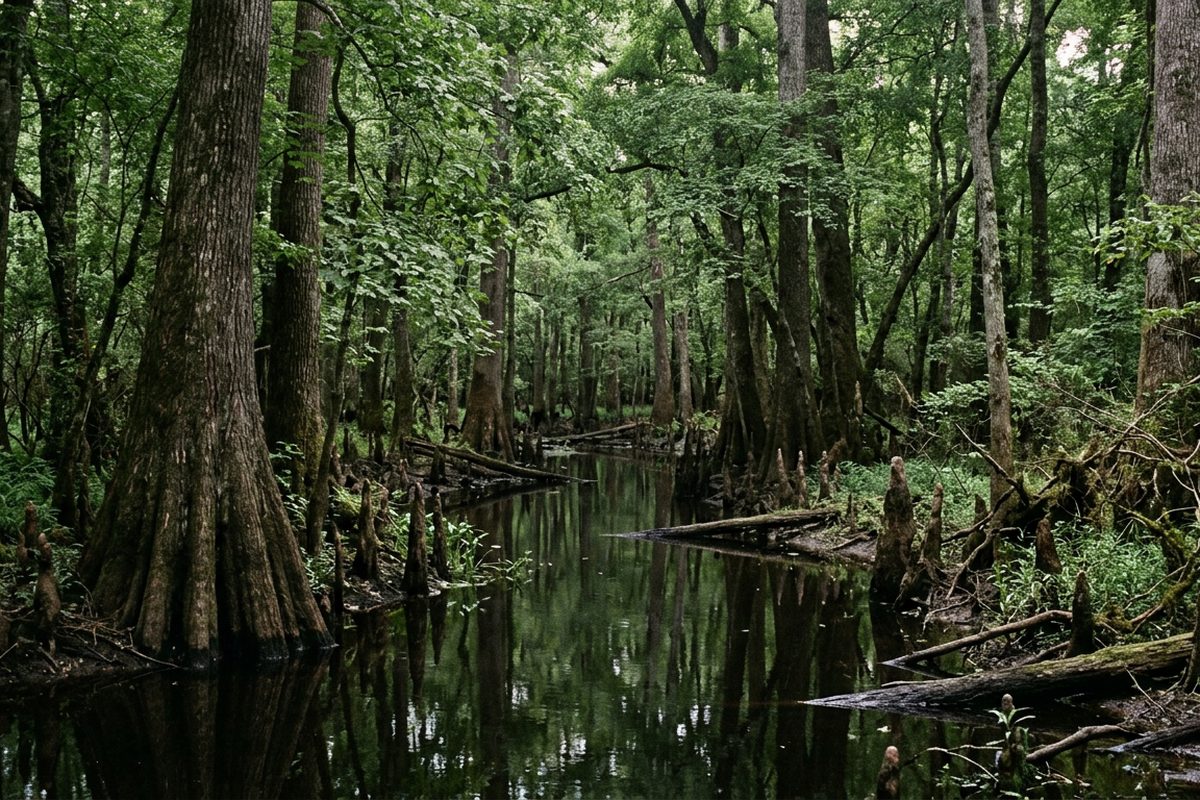
The tributary that joins the Mississippi east of the city is a different river entirely. It drops a few inches per mile, which means it barely flows, and it runs through cypress and tupelo swamp for most of its lower length.
The water is black, not brown. That is tannin from leaf litter rather than sediment, and on a still day it reflects like glass while being impossible to see into.
Why the trees look like that
Cypress buttress at the base because the ground is saturated and the trees need spread rather than depth. The knees, which are the woody projections coming up out of the water around them, are probably about stability too, though botanists have argued about it for a century.
Tupelo does the same thing with a swollen trunk base. The result is a forest that stands on flared feet in still water, and it does not look like anywhere else in the region.
Seeing it
From the water is the honest answer. A canoe or a small paddle boat on this tributary is the way it is meant to be seen, and because the current is so slow you can paddle upstream and come back down, which is not possible on the main river at any stage.
From the boardwalk, if you do not have a boat. There is about a mile of it through the swamp, it is level, and it is one of the few genuinely accessible places in this paper. It gets you among the trunks without a hull.
From the bank does not work. The bank, where there is one, is thicket.
Season
Summer is when it looks like the photographs, with full canopy and green light coming down through it. It is also when insects are at their worst, and that is not a small caveat: the mosquito conditions in a tupelo swamp in July are the most aggressive in this region.
Winter opens the canopy and drops the insects to nothing. The water is higher, the light is flat grey, and the trunks read more clearly. It is a completely different place and worth seeing twice.
The stage that matters
This tributary has its own gauge, and it is not the Memphis reading. Around three feet the channel is clear and paddleable. Above six, current picks up and strainers become genuinely dangerous. Below two, you drag over deadfall constantly.
The main river backs into the lower end of this tributary at high Mississippi stages, which reverses the flow. That is worth knowing before launching, and it is visible on the gauge as a rise with no local rain behind it.
Nothing on this page is sold, and no fee was taken for any place named on it.